
Blog

Avoidant Restrictive Food Intake Disorder (ARFID) and “Safe Food”
My partner recently asked, “You talk about safe foods, what does that actually mean? How is some food ‘safe’ and other food not?” I thought about this question for several minutes, trying to come up with an analogy that would make sense. One that would match the body sensation I
 Amber Dawn
Avoidant Restrictive Food Intake Disorder (ARFID) and the Absence of Hunger Cues
A friend and I were talking about our shared experience of not feeling hunger. We’ve both had our energy suddenly tank, our emotions go haywire and suddenly we’ve realized, “Oh wait, I haven’t put food in my body yet today.” When people around me hear I forget
 Amber Dawn
ARFID Bingo card
Avoidant Restrictive Food Intake Disorder
 Amber Dawn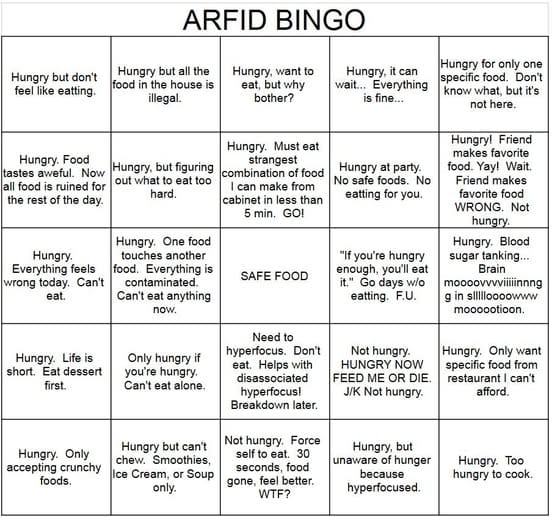
Part 5 - Invalidation of Sensory Experiences
Creating Safer Events and Spaces for Neurodivergent Dancers Series: An Introduction: Defining and Understanding Neurodivergence and Neurodiversity in Partner Dancing Part 1 - The 8 Senses Part 2 - Sensory Intensity Part 3 - A Sensory Lens for Dance Part 4 - Self-Protection & Overwhelm Part 5 - Invalidation of Sensory
 Amber Dawn
Part 4 - Self-protection & Overwhelm
Creating Safer Events and Spaces for Neurodivergent Dancers Series: An Introduction: Defining and Understanding Neurodivergence and Neurodiversity in Partner Dancing Part 1 - The 8 Senses Part 2 - Sensory Intensity Part 3 - A Sensory Lens for Dance Part 4 - Self-Protection & Overwhelm Part 5 - Invalidation of Sensory
 Amber Dawn
Part 3 - A Sensory Lens for Dance
Creating Safer Events and Spaces for Neurodivergent Dancers Series: An Introduction: Defining and Understanding Neurodivergence and Neurodiversity in Partner Dancing Part 1 - The 8 Senses Part 2 - Sensory Intensity Part 3 - A Sensory Lens for Dance Part 4 - Self-Protection & Overwhelm Part 5 - Invalidation of Sensory
 Amber Dawn
Part 2 - Sensory Intensity
Creating Safer Events and Spaces for Neurodivergent Dancers Series: An Introduction: Defining and Understanding Neurodivergence and Neurodiversity in Partner Dancing Part 1 - The 8 Senses Part 2 - Sensory Intensity Part 3 - A Sensory Lens for Dance Part 4 - Self-Protection & Overwhelm Part 5 - Invalidation of Sensory
 Amber Dawn
Part 1 - The 8 Senses
Creating Safer Events and Spaces for Neurodivergent Dancers Series: An Introduction: Defining and Understanding Neurodivergence and Neurodiversity in Partner Dancing Part 1 - The 8 Senses Part 2 - Sensory Intensity Part 3 - A Sensory Lens for Dance Part 4 - Self-Protection & Overwhelm Part 5 - Invalidation of Sensory
 Amber Dawn
Introduction: Creating Safer Events and Spaces for Neurodivergent Dancers Series
Creating Safer Events and Spaces for Neurodivergent Dancers Series: An Introduction: Defining and Understanding Neurodivergence and Neurodiversity in Partner Dancing Part 1 - The 8 Senses Part 2 - Sensory Intensity Part 3 - A Sensory Lens for Dance Part 4 - Self-Protection & Overwhelm Part 5 - Invalidation of Sensory
 Amber Dawn
PDA Resources
Pervasive Drive for Autonomy (Pathological Demand Avoidance) Ways you might try to offer support to someone who tends to shut down when a request is interpreted as a demand and they are struggling to do what is asked of them: -Turn a task into a game. -Turn a task into
 Neurodawnversity
A Portal to a Safe Place
A Portal Appears on Your Doorstep: For Those Unable to Reach Out During Shelter in Place Dear Friend, When our world went into Quarantine in early 2020 an excruciating silence enveloped me. I suspect it has surrounded you too? I see your shadow in the mist. The wind carries the
 Neurodawnversity
Stepping into the Lead
I’d wait for you, In the nebulous space between us, To take the lead, Consciously unconscious, I was too scared, To have a voice, To be felt, To be seen, Because I’d have to unlock my truth, To go back, To disarm past demons, To chant to myself, I’m here.
 Neurodawnversity
An Open Letter on Supporting Neurodivergent Children in Waldorf Schools
Dear Community, I recently received an email inviting my child to participate in Therapeutic Eurythmy from our Waldorf School. I understand the intent was to offer additional options for children in the school who would benefit from supports - however as a neurodivergent parent of two neurodivergent children - this
 Amber Dawn